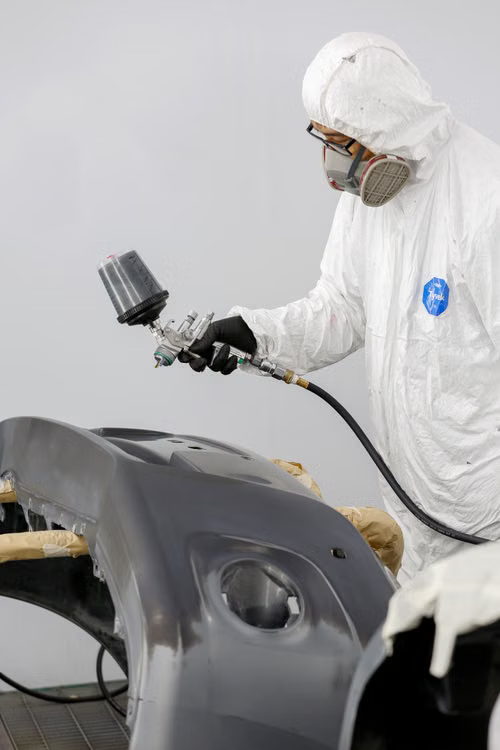
Spray paint looks simple from the outside. You point a can or a gun at the vehicle, you pull the trigger, and color lands on metal. Plenty of people have tried it on a scratched door panel over a weekend, and the result usually looks acceptable for about a week. Then it starts to change. What an auto body shop controls inside a paint booth has almost nothing to do with the spraying itself and everything to do with the air surrounding the car while the paint cures.
An auto body shop paint booth is a sealed room with a job description. It manages four things your driveway cannot manage at all. Air pressure. Temperature. Humidity. Particle count. Miss any one of them and the repair still looks correct on collection day, which is the part that catches people out.
Air Pressure And Airflow Control in a Paint Booth
A booth runs at positive pressure. Air inside pushes outward, so dust cannot drift in through gaps or when someone opens a door.
Air moves in one direction, usually down from the ceiling and out through grates in the floor. That downdraft carries overspray away from the panel instead of letting it settle back onto wet paint.
Your driveway does the opposite. Wind moves wherever it wants, and it carries pollen, road grit, and insects with it. Sacramento in spring is particularly unkind here, though I suppose most places are.
See also: Keeping Pets Safe From Ticks, Fleas, and Fire Ants in Central Texas
Temperature and Curing Standards for Automotive Paint
Modern automotive coatings cure chemically. They do not simply dry. Manufacturers publish a specific temperature range for that reaction to complete, and the range is narrower than most people assume.
Spray below it, and the paint stays soft underneath, even when the surface feels hard to the touch. Spray above it, and the solvent flashes off too fast, which traps gas inside the film.
A booth heats to a set bake temperature and holds it for a measured period. Outside, Sacramento hands you 104 degrees in July and 38 degrees in January, sometimes within the same fortnight.
Substrate temperature matters too. A panel sitting in direct sun can run twenty degrees hotter than the air around it, and paint reacts to the metal, not the forecast.
Humidity, Contamination, and Common Paint Defects
Moisture is the quiet one. Nobody thinks about it, and it causes more failures than dust does.
Uncontrolled conditions produce a predictable set of problems:
- Blushing, a milky haze forming when moisture gets trapped in the clear coat
- Solvent pop, small blisters where gas escaped after the surface had already skinned over
- Fisheye, circular craters caused by silicone or oil contamination on the panel
- Orange peel, uneven texture from wrong viscosity or wrong booth temperature
- Dust nibs, hard specks locked permanently under the clear
- Die-back, where gloss fades weeks after the repair looked perfect
Most of these only appear under direct sunlight at a low viewing angle. Under shop lights or on an overcast day, the panel passes inspection. Then you park outside in August and see it.
Surface Preparation Before Any Paint Reaches the Panel
The booth gets attention because it looks impressive. The preparation work before it decides more of the outcome.
Panels get cleaned with a degreaser, then wiped again with a tack cloth. Any wax, silicone, or fingerprint oil left behind will reject paint at that exact spot.
Sanding happens in stages, working through progressively finer grits. Skip a stage, and the scratch pattern from the coarse paper telegraphs through the finished clear coat.
Masking takes longer than most customers expect. Adjacent panels, glass, trim, and door gaps all need covering, and paper edges have to sit flat, or overspray finds the gap.
Filtration Standards in a Professional Auto Body Shop
Booth air passes through staged filters before it ever reaches the vehicle. Intake filters catch particles on the way in. Exhaust filters trap overspray on the way out.
Technicians wear full paint suits for a reason that surprises people the first time they hear it. Lint from ordinary clothing lands in the wet clear coat and stays there permanently.
Floors get wet down before a session. Surfaces get wiped. Movement inside the booth stays slow and deliberate because walking quickly stirs up whatever settled earlier.
It looks obsessive, and perhaps it is. The alternative is sanding a finished panel back and starting the whole process again.
Why Booth Conditions Affect Resale Value and Warranty Cover
A paint repair done in poor conditions fails on its own schedule. Sometimes eighteen months. Sometimes three years.
Clear coat lifts at the edges first. Then it peels. Once peeling starts, the only real fix involves stripping the panel and beginning again, at full cost, usually out of your own pocket because the original shop has moved on.
Buyers notice. Appraisers notice faster. A mismatched or failing panel signals a repair history and pulls value down even when the underlying structural work was sound.
Relux Collision handles paint and scratch repair in a controlled booth environment in Sacramento, backed by a limited lifetime warranty on repairs.
In Closing
When you collect a repaired vehicle, park it in direct sunlight and inspect the panel from a low angle. Texture differences, dust nibs, and color mismatch all reveal themselves there before they show anywhere else.